What is a sump and how does it work?
- Read time: 3 minutes
- Date: 05 Nov 2025
- Roof Drainage
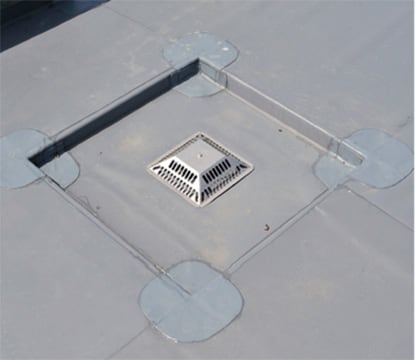
A sump is an area around a roof outlet which is lower than the main roof area. This is either a localised area around the outlet or a box gutter. A box gutter would normally run the length or width of the roof.

How does a sump work?
A sump or box gutter allows the water to build up around the outlet. This increases the head of water which in turn increases the pressure forcing more water through the outlet*. A sump or box gutter can vary in depth. Generally speaking, the deeper the sump, the greater the flow rate achieved by the outlet*. However, increasing the sump depth does have a diminishing advantage. The sump depth is also often governed by the insulation thickness. Good practice dictates that there should still be some insulation under the outlet to prevent cold bridging. This should be considered when the u-value calculation is being carried out. In our experience a sump of somewhere between 25 – 50mm is a good balance which increases the flow rate whilst leaving some insulation below the outlet.
A parapet outlet has a low flow rate due to the water draining horizontally. A sump can make a significant difference to this.
What plan size should a sump be?
There is no fixed size for a sump. However, making it small can make the detailing of the waterproofing difficult. Bearing in mind the sump will fill with water it is imperative that the joints are well executed. Somewhere around 500 x 500mm works well.
What are the advantages of a sump?
Can increase the flow rates of the outlets*
Can help prevent ponding water around the outlet
What are the disadvantages of a sump?
Requires extra detailing of the waterproofing membrane
Reduced thermal resistance
*Whilst a sump can significantly improve the flow rate of an outlet this depends on the outlet type, size and the leaf guard. Some outlets reach their filling limit without a sump. The maximum filling limit of a pipe is set out in the BS EN 12056-3:2000. This states that a pipe must not exceed 33% of capacity.