Frequently asked questions about strip sealants
- Read time: minutes
- Date: 24 Mar 2026
- Sheeting & Cladding
- Flat Roofing

Liner sheet end lap – A-3 x 9 x 15 / A-4 DIA x 12/ A-6 DIA x 8
Liner sheet side lap – PB50
Cladding outer sheet end lap - A-5 x 6 x 9.6
Cladding outer sheet side lap - A-5 x 6 x 9.6 / A-6 DIA x 8 / A-8 DIA x 6
Composite panel end lap – A-5 x 6 x 9.6 / AUF-6 x 50 x 8
Composite panel side lap – A-5 x 6 x 9.6 / A 6dia 8
Rooflights – A-5 x 6 x 9.6 / A-6 DIA x 8 / A-8 DIA x 6 / A-4 x 18 x 12 / A-3 x 9 x 15 / SEELEX BR
Metal Gutters – A-3 x 50 x 15 / A-5 x 6 x 9.6
Metal Flashings – A-3 x 9 x 15 / A-5 x 6 x 9.6 / A-6 DIA x 8
Foam Fillers – A-1.5 x 9 x 30 / SEELEX-BR
Roof and Wall Penetrations – FOILBAND
VCL or membrane seal – VCL-T-1 x 12 x 45 / VCL-T-2 x 15 x 22.5 / A-2 x 12 x 22.5
Fibre Cement sheets – A-8 DIA x 6 / A-10 DIA x 5
Fixfast offers the FS-3 x 12 x 15, which is an intumescent strip sealant tested in accordance with BS476 Part 22 1987. Which is primarily used to seal firewall applications, as it provides 30-minute smoke & fire resistance.
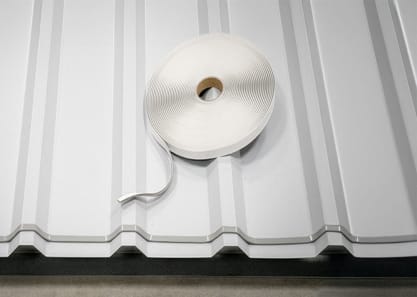
Butyl is a general-purpose synthetic rubber and has become a generic name in our industry for strip sealant in roofing applications, Fixfast SafeSeal® is a Class A Butyl strip sealant range, manufactured to a carefully controlled formulation of raw materials, the key ingredient being PIB (Polyisobutylene) which gives Fixfast SafeSeal® specific performance attributes to suit their applications
Impermeability to gas and moisture – for airtight structures
Weather and ozone resistance – for weathertightness in external environments
Flexibility for building and joint movement, and for thermal variations
Non-curing and long lasting to match building system service life expectations
NFRC – What is required?
The NFRC sets the performance standard for butyl strip sealants through Technical Bulletin 36 (TB36).
It classifies sealants into Class A (high performance) and Class B (minimum performance), based on testing for adhesion, creep, water resistance, compression, and long‑term durability.
Class A sealants are the industry‑preferred standard for metal roofing and cladding, particularly where airtightness, weathertightness, and long service life are required.Source: NFRC TB36 – Performance Standards for Butyl Strip Sealants
MCRMA – How and where should strip sealants be used?
The MCRMA provides design and installation guidance rather than product certification.
Its documents state that strip sealants are critical for airtightness, vapour control, and weathertightness, particularly at liner sheet laps, roof end laps, penetrations, ridges, and eaves.
Sealants must be continuously applied, correctly positioned, and fully compressed, and manufacturer’s system details must always be followed.Sources: MCRMA Guidance Documents
Industry takeaway
In practice, MCRMA guidance + NFRC TB36 Class A compliance is treated as the baseline requirement for strip sealants in UK metal roofing and cladding systems.
Incorrect size & shape butyl
It is key to make sure that the size and shape of the butyl is as per the manufacturer's install guides, as although many systems are similar, the strip sealant details are very specific to how the system is configured to make sure the building is airtight and watertight.
Incorrect installation
The location where you apply the strip sealant is vital, make sure to follow the specific system manufacturer's guidelines as to where the strip sealants should be applied. Other key points to note:
Make sure the sealant follows the profile’s crown and troughs without stretching the sealant.
Clean and dry the sheet/panel before application.
Grade of sealant
Double-check the grade of the butyl strip sealant you are installing against the system requirements and NFRC and MCRMA guidelines as per the above. Typically, a class A grade butyl strip sealant is required.
Install temperature
Make sure that the strip sealant is installed between 5°C and 40°C as if installed below 5°C, the sealant has a high chance of not compressing the required amount, causing issues later in the project.